Selected package
Leftover:
We use necessary cookies for the cart, session, and security. Analytics cookies help us improve the site and can be turned off. Marketing cookies are enabled only with your consent. Learn more
Lacrysil App
Add the store to your home screen for faster access and an app-like full-screen experience.
It installs in a couple of taps — here is how.
Tap in the Safari toolbar
Choose “Add to Home Screen”
To install the app, open this site in the Safari browser.
Search
Start typing to see suggestions.
Save to favorites
Compare
Sale ends in
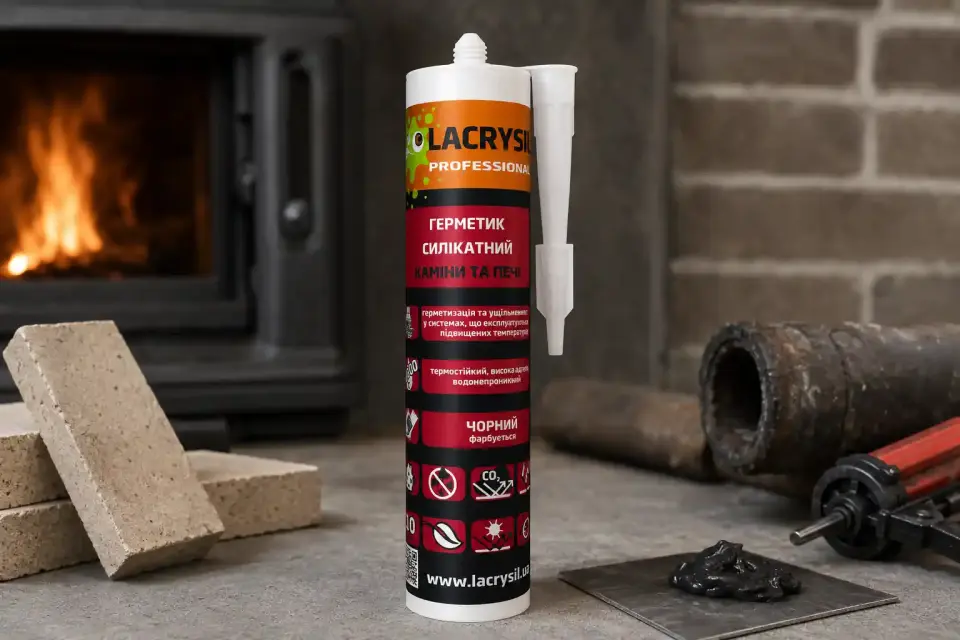
Fire-resistant silicate sealant for seams, joints, and gaps in fireplaces, stoves, and other structures exposed to high temperatures.
Maximum joint depth: 5 mm
Selected package
Leftover:
Cheaper package combination
pcs
Leftover:
Silicate sealant “Fireplaces and stoves” is a ready-to-use fire-resistant sealant for seams, joints, and gaps in structures exposed to direct fire, high temperatures, and aggressive environments.
It is used for fireplaces, stoves, and other heated assemblies where a rigid heat-resistant seal is required. The material is suitable for mineral substrates, glass, ceramic, stone, and primed metal according to the compatibility table.
After formation, the sealant layer is designed for an operating range of -40°C ... +1500°C. To give the layer water- and frost-resistant properties, the manufacturer recommends exposing it to direct fire or high temperatures after final formation.
Do not use the sealant for permanent water immersion, central heating systems, gas equipment, or elastic joints between structural elements. Avoid contact with skin and mucous membranes.
Before application, surfaces should be dry, strong, level, and cleaned of dust, dirt, rust, mould, grease, old coatings, and loose particles. Porous or weakened mineral surfaces should be pretreated with Lacrysil primer concentrate diluted 1:10 and dried. Metal surfaces should be cleaned or prepared with an anti-corrosion primer.
Apply the sealant in layers: the first layer thinly, the following layers more generously over the formed previous layer. Recommended seam width is 3-25 mm with overlap onto adjacent surfaces, and thickness is up to 5 mm. Level the layer with a spatula moistened in soapy water; formation takes 24-48 hours and may increase up to 5 days under unfavorable conditions.

Benefits
suitable for seams and joints in high-heat areas;
designed for operation in the -40°C ... +1500°C range after proper layer formation;
used for fireplaces, stoves, and other heated assemblies;
compatible with mineral substrates, glass, ceramic, stone, and primed metal;
black color helps make the seam less noticeable on dark heat-resistant surfaces;
0.55 kg packaging is convenient for filling several seams during installation or repair.
Where to use
sealing seams in fireplaces and stoves;
filling joints and gaps between heat-resistant structural elements;
repair work in areas exposed to direct fire or high temperature;
work on concrete, brick, gypsum, and other mineral substrates;
joints with glass, stone, ceramic, tile, and primed metal;
local construction and finishing work where a rigid heat-resistant seal is needed.
How to choose a variant
one variant is available on the product card: black sealant in 0.55 kg packaging;
choose black for dark fireplace or stove areas where the seam should not stand out;
for quantity planning, use the consumption reference: about 15 linear m for a 4x4 mm seam;
if you need an elastic joint, a material for gas equipment, central heating, or permanent water contact, choose another product;
for porous mineral substrates, plan preparation with Lacrysil primer concentrate diluted 1:10, and for metal use anti-corrosion preparation.
How to use
clean the substrate from dust, dirt, rust, mould, grease, old coatings, and loose particles;
treat porous or weakened mineral surfaces with Lacrysil primer concentrate diluted 1:10 and let them dry;
clean metal surfaces or prepare them with an anti-corrosion primer;
make sure the sealant, surfaces, and ambient temperature are within +5°C ... +35°C;
apply the first layer thinly, then apply the next layers more generously over the formed previous layer;
fill a seam 3-25 mm wide and up to 5 mm thick, level it with a spatula moistened in soapy water, and allow 24-48 hours for layer formation.
Compatibility table
| Material / Base | Concrete, brick, gypsum | Stone, granite, marble | Glass | Tile, ceramic, porcelain | Primed metal |
|---|---|---|---|---|---|
| Concrete, brick, gypsum | |||||
| Stone, granite, marble | |||||
| Glass | |||||
| Tile, ceramic, porcelain | |||||
| Primed metal |
FAQ: use, consumption, and common mistakes
What is it suitable for?
Fire-resistant silicate sealant for seams, joints, and gaps in fireplaces, stoves, and other structures exposed to high temperatures.
When is it not suitable?
Do not apply to wet, greasy, dusty, or weak substrates; permanent water immersion requires a separate compatibility check.
What is the consumption or yield?
Product specification guide: 15 linear m (4x4 mm seam). For an exact estimate, consider area, joint size, application method, and substrate condition.
How long does the layer dry or form?
Product specification guide: 24 - 48 hours. Cold, humidity, or a thick layer can increase the waiting time before loading.
What are the common mistakes?
Applying over an old weak layer, skipping cleaning, wrong joint geometry, and water contact before the layer forms.