


A crack near a fireplace or stove looks minor only until the first heating. In these joints, the seal is not decorative; it must withstand temperature.
Where a special sealant is needed
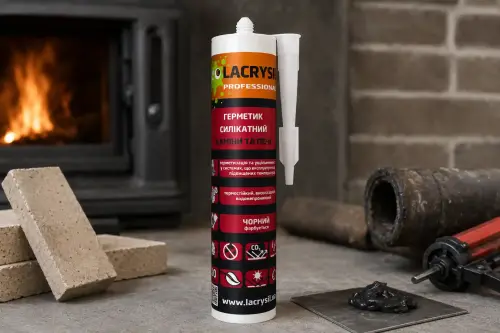
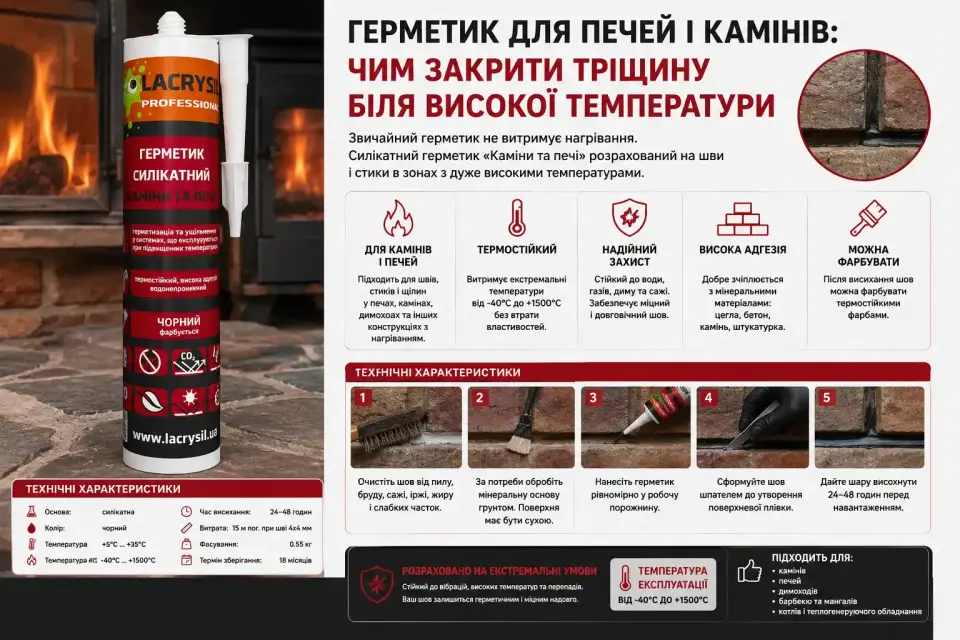
Fireplaces and Stoves silicate sealant is made for seams, joints, and gaps in fireplaces, stoves, and other structures exposed to high temperatures.
- fireplaces and stoves
- seams and joints in heated areas
- gaps on mineral substrates where heat resistance is required
What to check before application
For a high-temperature joint, the temperature figure is not the only factor. The surface must be dry, strong, and cleaned of dust, rust, grease, old coatings, and weak particles.
- application temperature: +5°C ... +35°C
- drying time: 24-48 hours
- operating temperature: -40°C ... +1500°C
- consumption: 17.6 linear m for a 4x4 mm joint from a 0.55 kg cartridge
- joint size: 3–25 mm wide, no more than 5 mm thick
Where this sealant does not fit
High heat resistance does not make the material universal. The manufacturer names the jobs it is not meant for. The +1500°C figure applies to a fully formed layer: to make the joint water- and frost-resistant, expose it to direct fire or high temperature after it has fully formed.
- central heating systems
- gas equipment
- elastic joints between structural elements: the seal is rigid and does not follow movement
- areas under constant water immersion
How to apply without peeling risk
Do not seal over soot or dust. The sealant must contact a strong substrate.
- clean the joint from dust, dirt, rust, and weak particles
- treat porous or damaged mineral substrates with Lacrysil primer concentrate diluted 1:10 and let them dry; clean metal or coat it with an anti-corrosion primer
- apply in layers: the first one thin, the next ones more generously over the formed layer
- level the joint straight away with a spatula dipped in soapy water
- let the layer form for 24–48 hours; in cold or damp conditions this can take up to 5 days
- once fully formed, expose the joint to fire or high temperature: this makes it water- and frost-resistant
Practical checkpoints
Key parameters for choosing and applying the material:
- material color: black
- pack size: 0.55 kg
- shelf life: 18 months
Materials for this job
For this scenario, use:
Main material: Silicate sealant “Fireplaces and stoves”
Frequently asked questions
Can it be applied without substrate preparation?
No. The substrate must be dry, strong, and clean: no dust, grease, water, weak old coatings, or loose particles. This directly affects adhesion and the appearance of the joint or coating.How long should you wait before loading or the next step?
The layer forms in 24–48 hours, up to 5 days in unfavourable conditions. After that the joint is exposed to fire or high temperature to make it water- and frost-resistant.How do you estimate how much material to buy?
Calculate from the joint length and cross-section. A 0.55 kg cartridge gives 17.6 linear m of a 4x4 mm joint; a 5x5 mm joint takes more, about 11 m per cartridge. Add a small reserve for uneven gaps.