Selected package
Leftover:
We use necessary cookies for the cart, session, and security. Analytics cookies help us improve the site and can be turned off. Marketing cookies are enabled only with your consent. Learn more
Lacrysil App
Add the store to your home screen for faster access and an app-like full-screen experience.
It installs in a couple of taps — here is how.
Tap in the Safari toolbar
Choose “Add to Home Screen”
To install the app, open this site in the Safari browser.
Search
Start typing to see suggestions.
Save to favorites
Compare
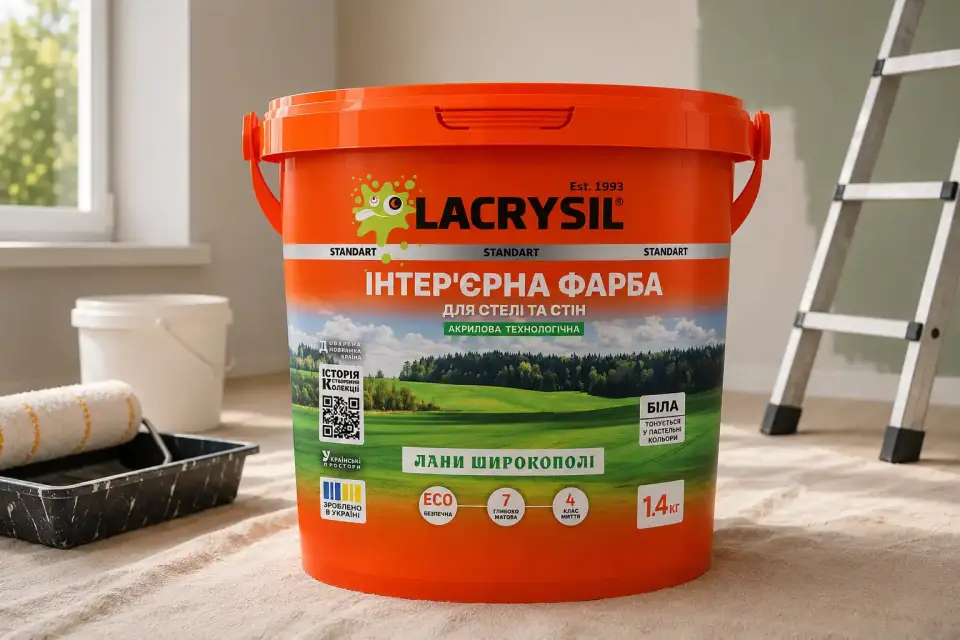
Interior acrylic water-dispersion paint for decorative finishing of walls and ceilings in general-purpose indoor rooms.
Selected package
Leftover:
Cheaper package combination
pcs
Leftover:
Wide Fields interior acrylic water-dispersion paint is intended for decorative painting of walls and ceilings inside general-purpose rooms.
The paint is used on prepared traditional building substrates, including concrete and brick, and for painting wallpaper on cellulose-paper and fiberglass bases.
The coating has a deep matte appearance, vapor permeability, washability class 3, and hiding power class 3. This combination suits interior surfaces where an even white finish without excessive gloss is needed.
Before application, clean the substrate from dust, dirt, unstable coatings, and poorly bonded particles. The surface should be dry, strong, and level; prepare it according to the condition of the material if needed.
Mix the paint until homogeneous and apply it at temperatures from +5°C to +35°C. If needed, thin the product with water according to the manufacturer’s recommendations.

What is it suitable for?
Interior acrylic water-dispersion paint for decorative finishing of walls and ceilings in general-purpose indoor rooms.
When is it not suitable?
Do not apply over dust, grease, moisture, chalky or weak coatings; difficult substrates need primer or a test area.
What is the consumption or yield?
No separate consumption value is listed, so estimate from area, joint size, or recommendations for the specific application method.
How long does the layer dry or form?
Let the layer fully form before loading. For difficult conditions, make a test area and check the instructions.
What are the common mistakes?
Painting a weak base without primer, applying too thick a layer, wrong application temperature, and rushing between coats.