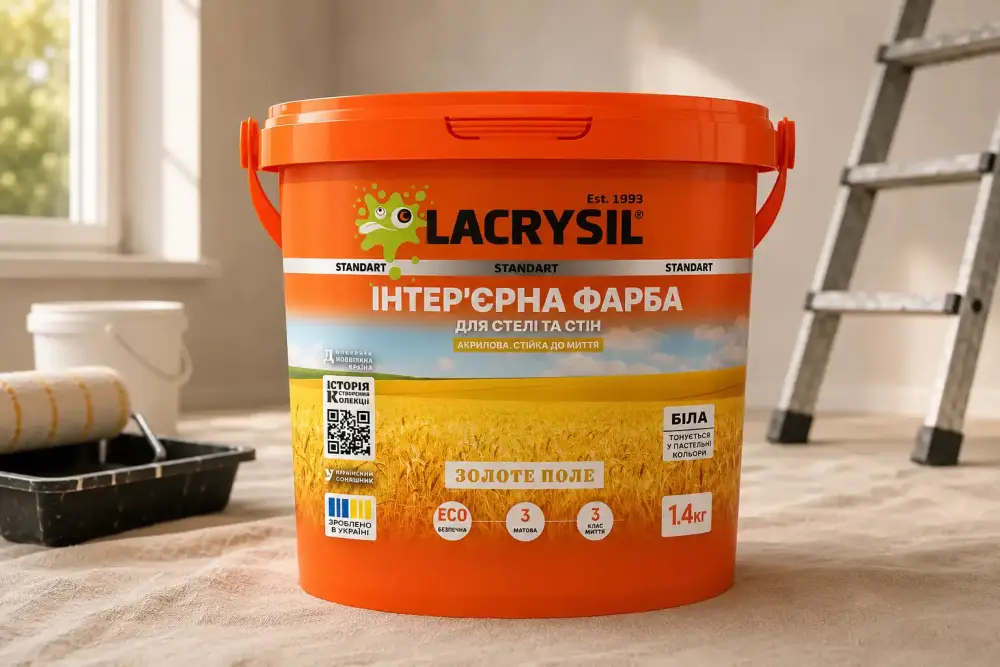
Golden field interior acrylic paint for ceilings and walls
Color
Packaging
from 229.00 ₴
We use necessary cookies for the cart, session, and security. Analytics and marketing cookies are enabled only after your choice. Learn more
Lacrysil App
Add the store to your home screen or desktop for faster access and an app-like full-screen experience.
Catalog
Popular categories
Search
Start typing to see suggestions.
Save to favorites
Add to compare
Interior latex water-dispersion paint for a matte coating on walls, ceilings, and wallpaper in residential and office spaces.
4 available
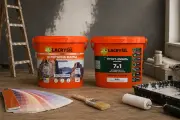
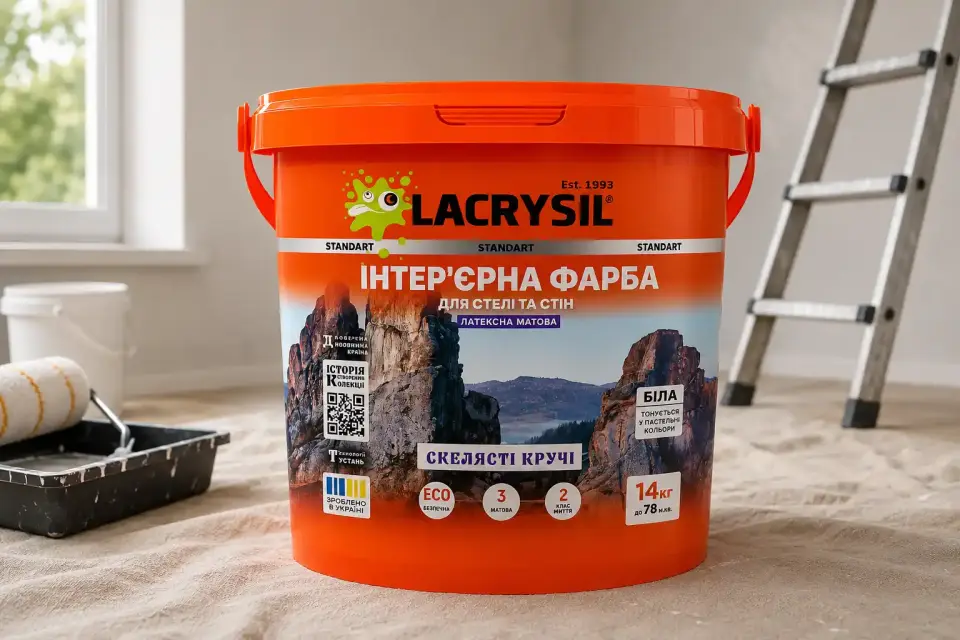
Rocky cliffs interior latex water-dispersion paint is intended for interior finishing work in residential and office spaces. It forms a matte coating for walls and ceilings, helps visually even out the substrate, and gives the surface a neat finish.
The paint is suitable not only for traditional mineral substrates, but also for painting wallpaper on cellulose-paper and fiberglass bases. This is convenient when an interior needs to be refreshed without fully replacing the wall covering.
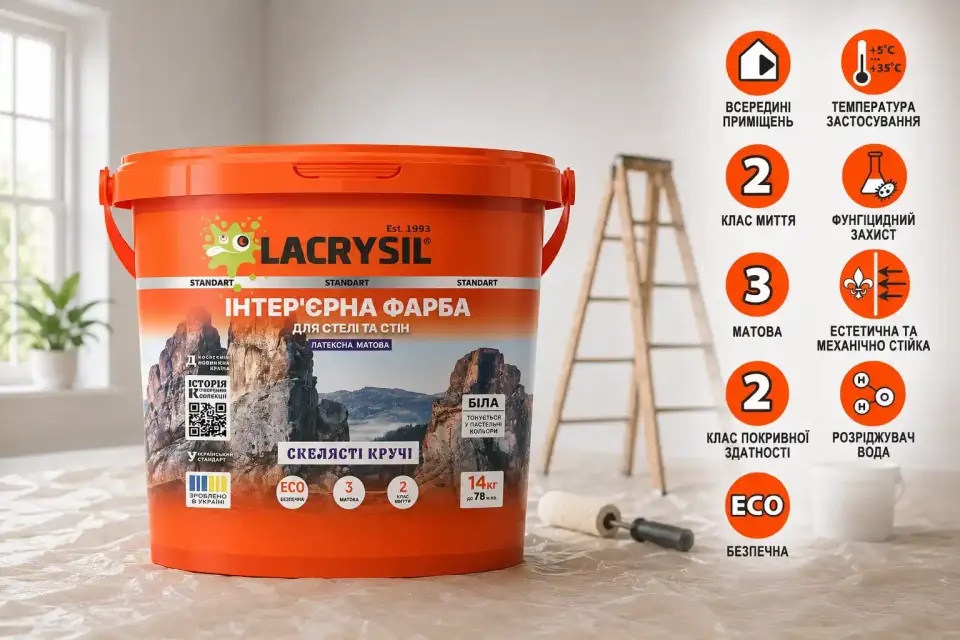
The coating has matte gloss level 3, hiding power class 2, and washability class 2. The material has fungicidal protection, thins with water, and creates an aesthetic mechanically resistant coating for everyday use.
The paint is intended for indoor application at +5°C ... +35°C. Before work, clean the substrate from dust, dirt, unstable old coatings, and poorly bonded particles. The surface should be dry, strong, and level.
Mix the paint until homogeneous before application. If needed, it can be thinned with water according to the manufacturer’s recommendations. For an even result, follow the application conditions, substrate preparation, and drying time between coats.
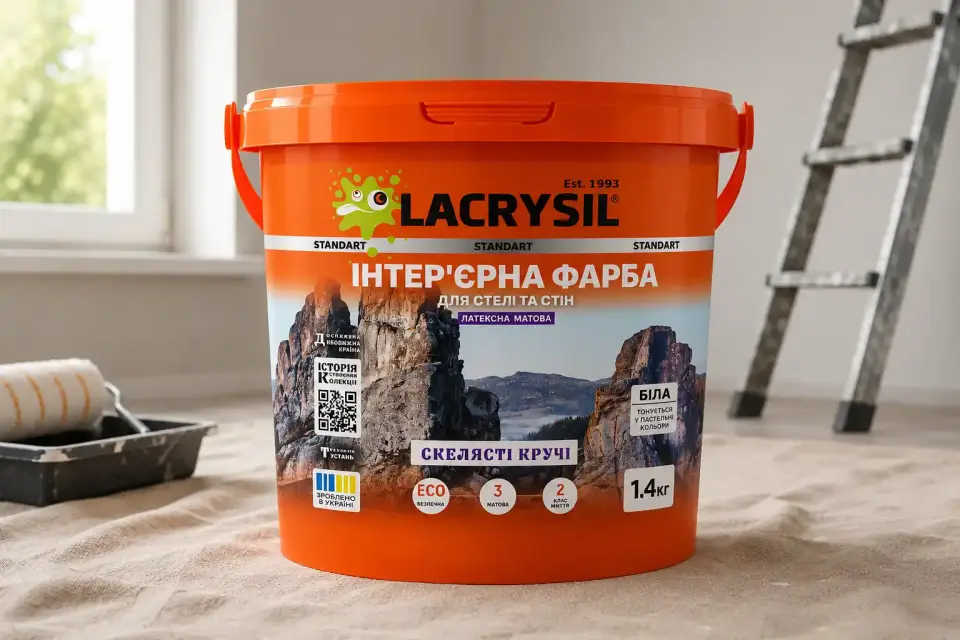
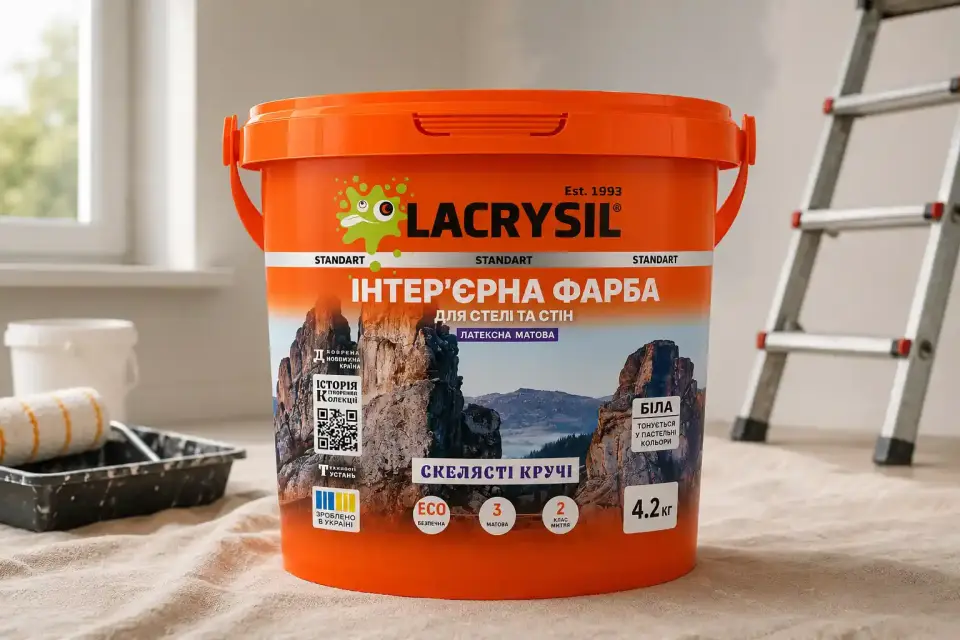
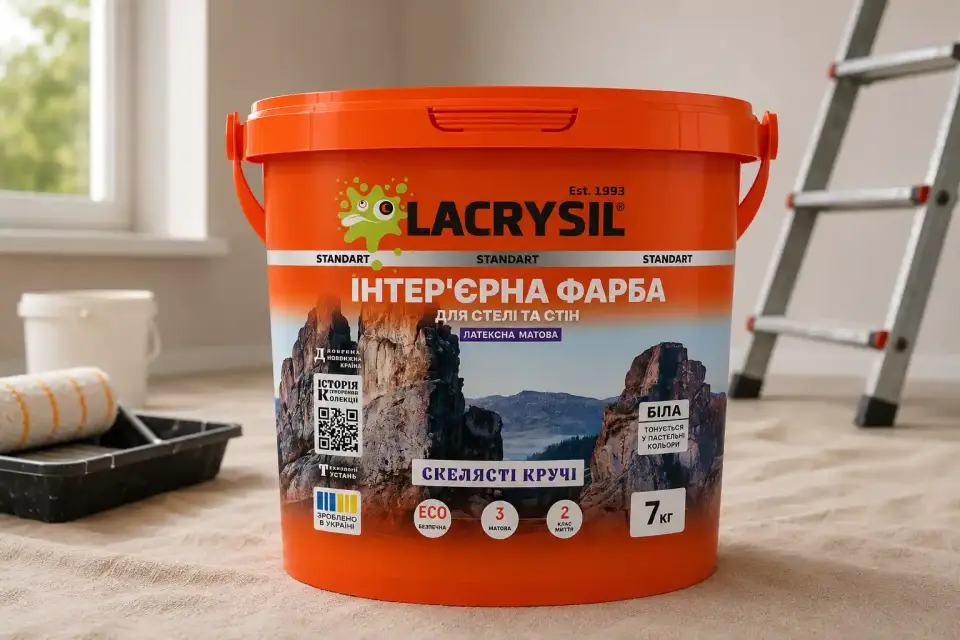
White color can be used as a ready matte finish or as a base for a light interior. The 1.4 kg pack is convenient for small areas, 4.2 kg for a single room or wall, and 7 kg or 14 kg for a larger amount of painting work.
What is it suitable for?
Interior latex water-dispersion paint for a matte coating on walls, ceilings, and wallpaper in residential and office spaces.
When is it not suitable?
Do not apply over dust, grease, moisture, chalky or weak coatings; difficult substrates need primer or a test area.
What is the consumption or yield?
No separate consumption value is listed, so estimate from area, joint size, or recommendations for the specific application method.
How long does the layer dry or form?
Let the layer fully form before loading. For difficult conditions, make a test area and check the instructions.
What are the common mistakes?
Painting a weak base without primer, applying too thick a layer, wrong application temperature, and rushing between coats.
1 similar products
Color
Packaging
from 229.00 ₴