Selected package
Leftover:
We use necessary cookies for the cart, session, and security. Analytics cookies help us improve the site and can be turned off. Marketing cookies are enabled only with your consent. Learn more
Lacrysil App
Add the store to your home screen for faster access and an app-like full-screen experience.
It installs in a couple of taps — here is how.
Tap in the Safari toolbar
Choose “Add to Home Screen”
To install the app, open this site in the Safari browser.
Search
Start typing to see suggestions.
Save to favorites
Compare
Universal acrylic rubber paint for protective and decorative painting of surfaces outdoors and indoors.
Selected package
Leftover:
Cheaper package combination
pcs
Leftover:
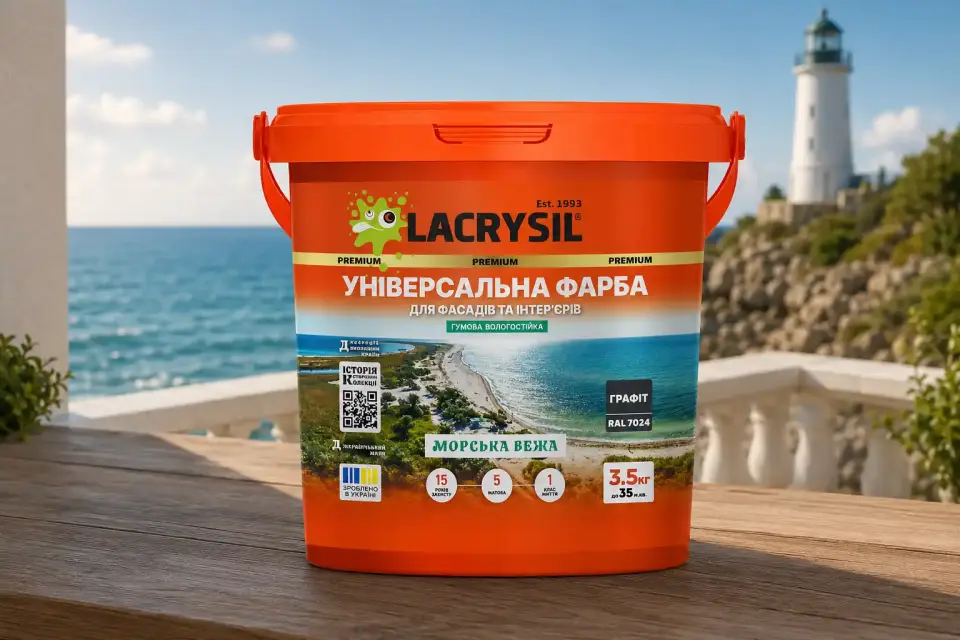
Sea Tower universal acrylic rubber paint is intended for protective and decorative painting of surfaces outdoors and indoors.
The paint is used for slate, roof tiles, ondulin, galvanized steel, aluminum, ferrous metal, profiled sheeting, asphalt, asbestos cement, concrete, foam concrete, aerated concrete, brick, plastered and filled surfaces, plywood, chipboard, cement-bonded particleboard, fibreboard, wood, plasterboard, and wallpapered surfaces.
The product specifications state outdoor and indoor use, washability class 1, hiding power class 1, matte level 5, fungicidal protection, water thinning, and a 15-year protection period when the manufacturer’s recommendations are followed.
The range has several ready RAL colors and pack sizes of 1.2 kg, 3.5 kg, 6 kg, and 12 kg. This helps choose a variant for a small repair, a separate structure, or a larger amount of work.
Before application, clean the surface from dust, dirt, unstable coatings, and poorly bonded particles. The substrate should be dry, strong, and level, and the application temperature should be within +5°C ... +35°C.

What is it suitable for?
Universal acrylic rubber paint for protective and decorative painting of surfaces outdoors and indoors.
When is it not suitable?
Do not apply over dust, grease, moisture, chalky or weak coatings; difficult substrates need primer or a test area.
What is the consumption or yield?
No separate consumption value is listed, so estimate from area, joint size, or recommendations for the specific application method.
How long does the layer dry or form?
Let the layer fully form before loading. For difficult conditions, make a test area and check the instructions.
What are the common mistakes?
Painting a weak base without primer, applying too thick a layer, wrong application temperature, and rushing between coats.