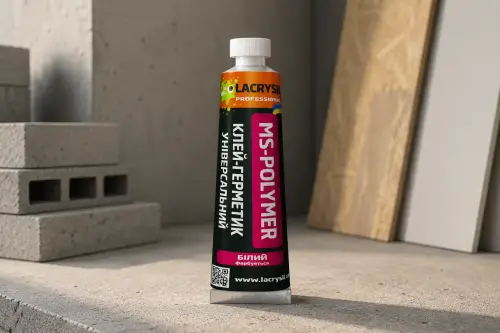






What does sealant consumption depend on?
The amount of sealant needed for the job depends on several factors.
1. Seam width
The wider the seam, the more material is needed to fill it.
2. Seam depth
Deep joints require a larger volume of sealant.
3. Surface type
Porous materials (concrete, plaster, brick) may slightly increase material consumption.
4. Application method
With uniform application from an assembly gun, the sealant consumption will be lower.
Sealant calculation formula
For an approximate calculation, you can use a simple formula:
Consumption (ml/m) = joint width (mm) × joint depth (mm)
For example:
seam 5 × 5 mm = 25 ml per 1 meter
seam 10 × 5 mm = 50 ml per 1 meter
The standard sealant cartridge has a volume of 280 ml , therefore:
with a seam of 5 × 5 mm, it will be enough for about 11–12 meters
with a seam of 10 × 5 mm - approximately 5–6 meters
These values are approximate and may vary depending on application conditions.
Packaging formats and approximate consumption of MS Polymer adhesive sealant
Adhesive sealant based on MS polymer is available in several formats, which allows you to choose the optimal option for different volumes of work.
Available formats:
0.4 kg - for large installation and construction works (280 ml cartridge ≈ 400 g)
0.28 kg - standard cartridge for assembly gun
85 g (50 ml) - compact format for small repairs
50 g (50 ml) - convenient for small household tasks and spot repairs
Formula for calculating seam length
The seam length is determined by the formula:
l = m / (ρ × S)
where:
l — seam length, m
m is the mass of the sealant, g
ρ is the density of the sealant, g/ml
S — cross-sectional area of the sealant, mm²
Also, the required mass of sealant, knowing the length and shape of the seam, can be determined using the appropriate formula.
Density of sealant for calculations:
MS white — 1.6 g/ml
MS transparent — 1.09 g/ml
Example of calculations
1. It is necessary to seal 7 m of gaps measuring 3 × 6 mm with white MS polymer.
In this case, 1 cartridge (400 g) will be enough, and some of the material will even remain.
2. How many meters of strip can be obtained from a 50 g tube of transparent MS-polymer if the diameter of the “sausage” is 5 mm?
* The examples are theoretical. In practice, the results may differ due to the impossibility of maintaining the same cross-section along the entire length of the seam. Deviations are possible both in the larger and smaller direction.
Example of calculating the amount of sealant
Let's say you need to seal 15 meters of a seam measuring 8 × 6 mm .
48 g × 15 m = 720 g of sealant
For such work you will need approximately:
2–3 cartridges of 0.28 kg , or
2 packages of 0.4 kg each
Advice
It is recommended to add 10–15% material reserve before purchasing , as actual consumption may vary depending on the type of surface, porosity of the substrate and application method.
Where is MS-polymer adhesive sealant used?
The material has universal application and is suitable for working with various surfaces:
metal
aluminum
glass and mirrors
wood and painted wood
concrete and plaster
ceramic tile
plastic (PVC, polycarbonate, polyacrylates)
natural and decorative stone
It is used for:
sealing of window and door blocks
installation of ventilation systems
facade works
gluing of building materials
roof sealing (tiles, slate, metal)
The material is also used in the furniture, automotive, shipbuilding, and food industries .
How to apply sealant correctly
To reduce material consumption and get a neat seam, it is recommended to follow several rules:
Clean the surface from dust, grease and dirt.
If necessary, lightly moisten the base.
Apply the sealant using a caulking gun in an even strip.
Smooth the seam with a spatula or a special tool.
At a temperature of +23 °C, a film forms on the surface after approximately 15 minutes , and complete hardening occurs within 24–48 hours, depending on the layer thickness.