Selected package
Leftover:
We use necessary cookies for the cart, session, and security. Analytics cookies help us improve the site and can be turned off. Marketing cookies are enabled only with your consent. Learn more
Lacrysil App
Add the store to your home screen for faster access and an app-like full-screen experience.
It installs in a couple of taps — here is how.
Tap in the Safari toolbar
Choose “Add to Home Screen”
To install the app, open this site in the Safari browser.
Search
Start typing to see suggestions.
Save to favorites
Compare
Elastic, waterproof, and antifungal product for extreme humidity conditions.
Maximum joint depth: 5 mm
Selected package
Leftover:
Cheaper package combination
pcs
Leftover:
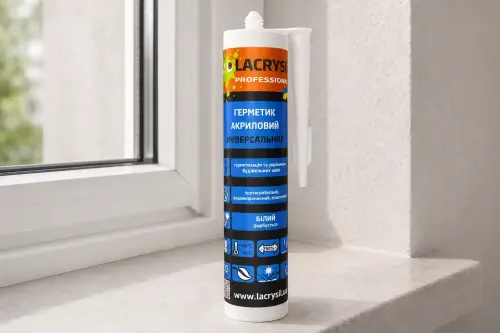
Acrylic sealant “Sanitary” is an elastic, waterproof, and antifungal product for extreme humidity conditions.
The product is intended for sealing gaps, seams, and joints of construction elements during construction, decorative finishing, and repair work, especially in rooms operated under increased humidity. The sealant is environmentally clean and safe for human health and the environment, does not promote parasitic microflora, is resistant to UV radiation and aggressive external influences, and forms a water-resistant but vapor-permeable layer that can retain consumer properties across a wide temperature range.
Application: working surfaces must be dry, strong, and level, cleaned of dust, dirt, mould, grease, old coating residues, other contaminants, and poorly bonded particles. Natural stone surfaces, damaged surfaces, or porous substrates should be pretreated with a 1:10 working solution of TM Lacrysil primer concentrate and dried. Before work, make sure the sealant and ambient temperature is within (+5...+35)°C. Carefully fill the working cavity with an even continuous layer of sealant and use a spatula moistened in soapy water or a special template to form the desired seam shape. Seam width should not exceed 12 mm; initial skin formation at room conditions on moisture-absorbent surfaces takes 20-30 minutes. Final layer formation takes approximately 2 days, depends on many parameters, and may increase up to 5 days under unfavorable conditions.

Compatibility table
| Material / Base | Concrete, brick, gypsum, plasterboard | Stone, granite, marble | Mirror, glass | Wood, chipboard, fiberboard, MDF, plywood | Tile, ceramic, porcelain | Primed metal | Plastic, PVC | Polystyrene |
|---|---|---|---|---|---|---|---|---|
| Concrete, brick, gypsum, plasterboard | ||||||||
| Stone, granite, marble | ||||||||
| Mirror, glass | - | |||||||
| Wood, chipboard, MDF, fiberboard, plywood | ||||||||
| Tile, ceramic, porcelain | - | |||||||
| Primed metal | ||||||||
| Plastic, PVC | - | - | - | |||||
| Polystyrene |
FAQ: use, consumption, and common mistakes
What is it suitable for?
Elastic, waterproof, and antifungal product for extreme humidity conditions.
When is it not suitable?
Do not apply to wet, greasy, dusty, or weak substrates; permanent water immersion requires a separate compatibility check.
What is the consumption or yield?
Product specification guide: 15 linear m (4x4 mm seam). For an exact estimate, consider area, joint size, application method, and substrate condition.
How long does the layer dry or form?
Product specification guide: 48 hours. Cold, humidity, or a thick layer can increase the waiting time before loading.
What are the common mistakes?
Applying over an old weak layer, skipping cleaning, wrong joint geometry, and water contact before the layer forms.
1 similar products