Save to favorites

Add to compare

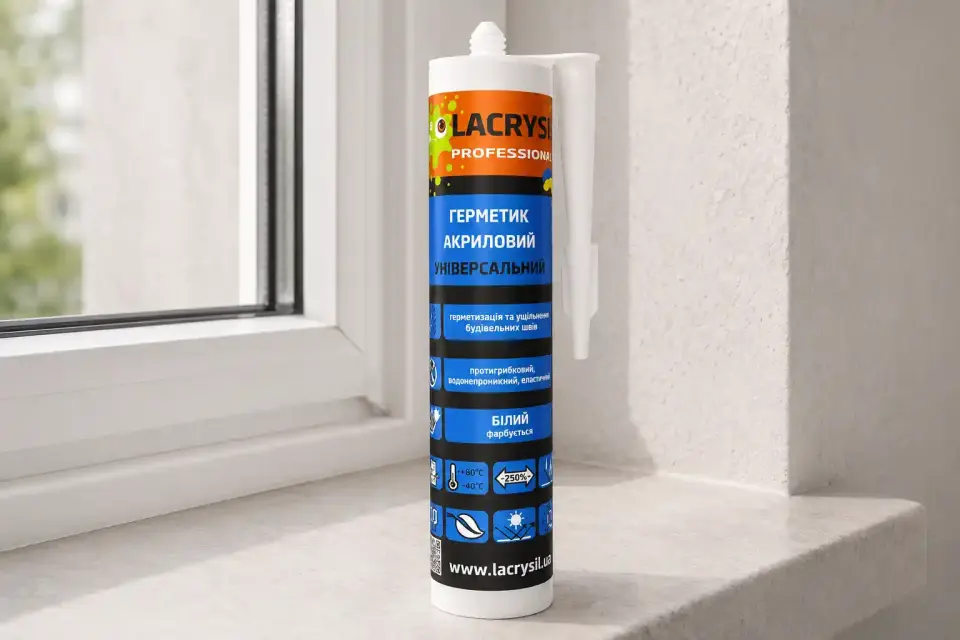
Acrylic sealant “Universal”

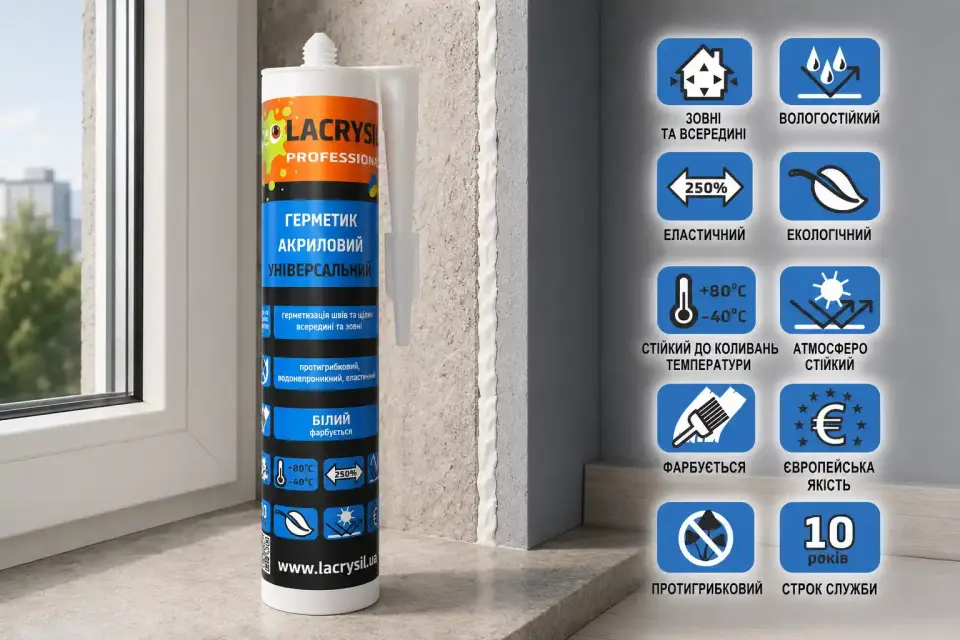
White acrylic sealant for sealing seams, joints, and gaps in construction, repair, and finishing work.

Specifications

Consumption:
15 linear m (4x4 mm seam)
Storage term:
18 months
Drying time:
24 - 48 hours
Operating temperature:
-40°C ... +80°C
Base:
copolymer-acrylate
Application temperature:
+5°C ... +35°C

Choose a variant

1 available

Color: White
Packaging: 0.4 kg

Sealant calculator

Coverage reference: 15 linear m (4x4 mm seam)

How will you apply?

Description

Acrylic sealant “Universal” is designed for neat sealing of gaps, seams, and joints in construction assemblies. It is used when a joint needs to be filled, drafts reduced, and an even seam formed without complex installation.

The sealant is suitable for window and door blocks, skirting boards, window sills, thermal insulation system elements, and repair or decorative finishing tasks. The material forms a dense water-resistant yet vapor-permeable layer and can be used indoors and outdoors when manufacturer recommendations are followed.

Before application, surfaces should be strong, dry, and cleaned of dust, dirt, rust, old paint, layers, and loose particles. Porous substrates should be pretreated with Lacrysil primer concentrate diluted 1:10.

Apply the sealant evenly in a continuous layer, then shape the seam with a spatula or a special template. The seam width should not exceed 12 mm.

Use at +5°C ... +35°C. Low temperature and high humidity may slow curing. Do not apply during rain or use in contact with stainless steel for seams that are permanently submerged under water.

Benefits
  • suitable for sealing gaps, seams, and joints;
  • used for window and door blocks, skirting boards, window sills, and thermal insulation systems;
  • forms a dense water-resistant yet vapor-permeable layer;
  • does not promote mould or fungal growth when applied correctly;
  • can be used indoors and outdoors;
  • white color is convenient for neat repair and finishing seams.
Where to use
  • sealing gaps, seams, and joints;
  • sealing connections around window and door blocks;
  • work with skirting boards and window sills;
  • installation and repair of thermal insulation system elements;
  • construction and decorative finishing work;
  • substrates such as concrete, brick, gypsum, plasterboard, wood, tile, primed metal, and other compatible materials.
How to choose a variant
  • 0.4 kg suits household repair, local installation, and sealing small or medium areas;
  • choose white for light-colored seams, junctions, and finishing work;
  • for seams up to 12 mm, this format is convenient when even filling and shaping with a spatula are needed;
  • if the material will be in constant contact with water, choose a specialized product for those conditions.
How to use
  • clean the surface from dust, dirt, rust, old paint, layers, and loose particles;
  • treat porous substrates with Lacrysil primer concentrate diluted 1:10;
  • make sure the application temperature is within +5°C ... +35°C;
  • apply the sealant evenly in a continuous layer into the seam or gap;
  • shape the seam with a spatula or a special template;
  • allow the layer to form: about 2 days on moisture-absorbent surfaces and up to 5 days on non-absorbent surfaces, depending on conditions.
Compatibility table
Material / Base Concrete, brick, gypsum, plasterboard Stone, granite, marble Mirror, glass Wood, chipboard, fiberboard, MDF, plywood Tile, ceramic, porcelain Primed metal Plastic, PVC Polystyrene
Concrete, brick, gypsum, plasterboard
Stone, granite, marble
Mirror, glass -
Wood, chipboard, MDF, fiberboard, plywood
Tile, ceramic, porcelain -
Primed metal
Plastic, PVC - - -
Polystyrene
FAQ: use, consumption, and common mistakes
  • What is it suitable for?
    White acrylic sealant for sealing seams, joints, and gaps in construction, repair, and finishing work.

  • When is it not suitable?
    Do not apply to wet, greasy, dusty, or weak substrates; permanent water immersion requires a separate compatibility check.

  • What is the consumption or yield?
    Product specification guide: 15 linear m (4x4 mm seam). For an exact estimate, consider area, joint size, application method, and substrate condition.

  • How long does the layer dry or form?
    Product specification guide: 24 - 48 hours. Cold, humidity, or a thick layer can increase the waiting time before loading.

  • What are the common mistakes?
    Applying over an old weak layer, skipping cleaning, wrong joint geometry, and water contact before the layer forms.

Video
Reviews (0)

Similar products

1 similar products