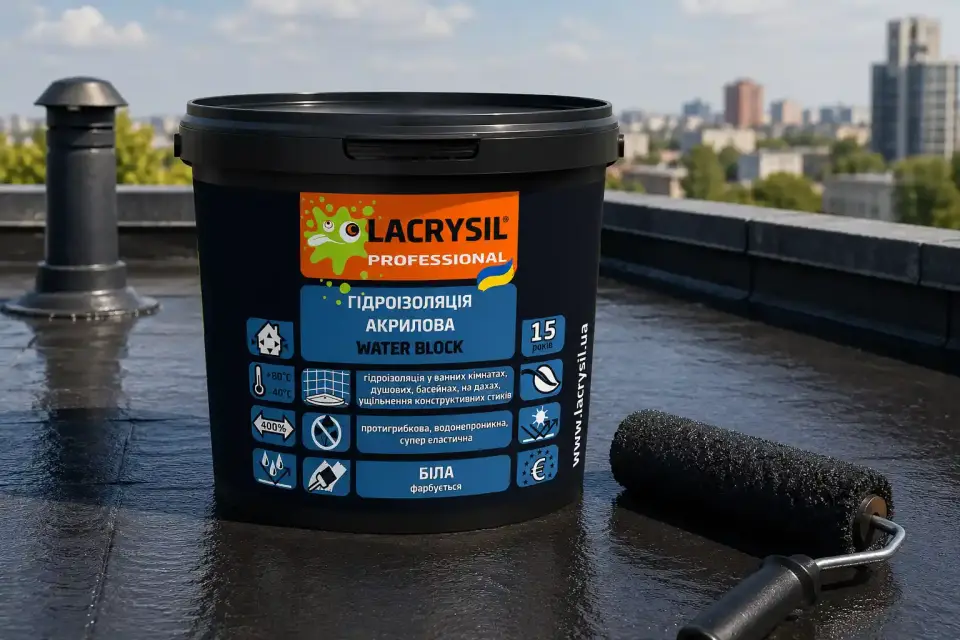
Water Block acrylic waterproofing is a one-component water-resistant material for exterior and interior use.
The product is used for sealing and waterproofing seams, joints, and gaps between building structures. It is also suitable for waterproofing surfaces exposed to high humidity, frequent water contact, or prolonged immersion.
The material is used to create a waterproofing membrane when installing tile and roll materials in sanitary and hygienic premises, as well as waterproofing layers under underfloor heating systems. It is designed for use with most traditional construction materials, enamelled surfaces, and glass surfaces.
The substrate must be dry, strong, level, and free from dust, dirt, mold, grease stains, old coating remnants, other contamination, and particles that are poorly bonded to the surface. Metal surfaces should be protected against corrosion by phosphating or another suitable method before application.
Old tiled coatings, natural stone products, porous or weakened substrates should be treated with TM Lacrysil primer concentrate diluted 1:10 or a 1:10 aqueous solution of the acrylic waterproofing itself, then dried. Before application, stir the product until uniform and make sure the material and ambient temperature are within +5°C ... +35°C.
To seal seams and gaps, fill the working cavity with an even continuous layer of the product and form the required joint shape. To create waterproofing coatings and membranes, apply the material to a primed and dried surface using a spatula, brush, or roller; apply the second and subsequent layers crosswise.
Apply waterproofing in layers no thicker than 1 mm until total coating thickness reaches at least 2 mm. Each next layer should be applied after the previous one dries. One layer forms within 24-48 hours, the final layer requires at least 72 hours, and for surfaces such as pools the coating should be protected with film and kept away from moisture for 7-10 days.