Selected package
Leftover:
We use necessary cookies for the cart, session, and security. Analytics cookies help us improve the site and can be turned off. Marketing cookies are enabled only with your consent. Learn more
Lacrysil App
Add the store to your home screen for faster access and an app-like full-screen experience.
It installs in a couple of taps — here is how.
Tap in the Safari toolbar
Choose “Add to Home Screen”
To install the app, open this site in the Safari browser.
Search
Start typing to see suggestions.
Save to favorites
Compare
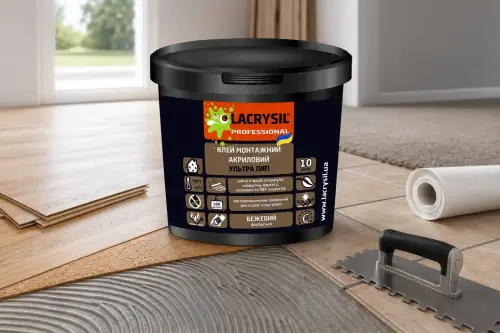
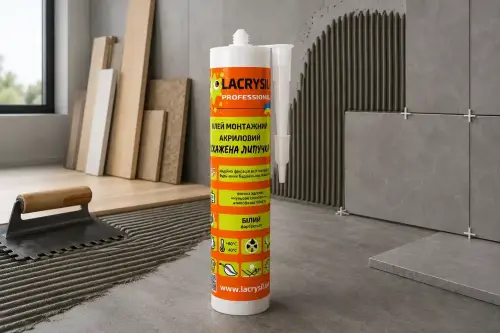
Acrylic adhesive for facing and tiling work with tile, mosaic, natural and artificial stone on floors, wall panels, facades, terraces, and in humid rooms.
Selected package
Leftover:
Cheaper package combination
pcs
Leftover:
Acrylic adhesive “Tile, Mosaic, Stone” is designed for facing and tiling work when tile, mosaic, or stone needs to be fixed to a traditional construction surface.
The adhesive is used for long-term fixing of ceramic, glass, and faience tile, artificial and natural stone materials, and mosaic elements of different types on floors and wall panels. It can also be used when installing plasterboard structures, thermal insulation systems, and underfloor heating systems.
The material is suitable for interior and exterior work: balconies, terraces, facades, kitchens, laundry rooms, bathrooms, and other high-humidity areas. According to the manufacturer’s intended use, it can be an alternative to dry building mixes for suitable facing tasks.
Before application, working surfaces must be dry, strong, level, and cleaned of dust, dirt, mold, grease stains, old coating residues, layers, and particles that are poorly bonded to the substrate. Natural stone products with signs of deterioration or porous structure should be pre-treated with Lacrysil primer concentrate diluted 1:10 and dried.
Stir the adhesive until uniform and apply a sufficient amount to one contact surface. On substrates that absorb moisture well, apply a continuous 1-6 mm layer and distribute it evenly with a notched trowel while removing excess adhesive. If the surfaces have limited absorption, apply the adhesive in spots so moisture can escape during seam formation; do not allow adhesive strips to merge when pressing the surfaces together.
After application, carefully join the surfaces, press firmly and evenly, and fix for a few seconds. The adhesive layer should be as thin as possible within the fixing technology for the specific structure. Adjustment time is 15-20 minutes; work should be carried out at +5°C ... +35°C.

| Material / Base | Compatible |
|---|---|
| Concrete, brick, gypsum, plasterboard | |
| Stone, granite, marble | |
| Wood, chipboard, fiberboard, MDF, plywood, OSB | |
| Tile, ceramic, mosaic |
What is it suitable for?
Acrylic adhesive for facing and tiling work with tile, mosaic, natural and artificial stone on floors, wall panels, facades, terraces, and in humid rooms.
When is it not suitable?
Do not use as a replacement for mechanical fixing where the element manufacturer requires anchors or dowels; do not bond over dust, grease, or weak layers.
What is the consumption or yield?
Product specification guide: spot application - 0.3 - 0.4 kg/m²; with spatula - 0.8 - 1.2 kg/m². For an exact estimate, consider area, joint size, application method, and substrate condition.
How long does the layer dry or form?
Product specification guide: 24 - 48 hours. Cold, humidity, or a thick layer can increase the waiting time before loading.
What are the common mistakes?
Weak substrate preparation, loading too early, uneven pressing, and choosing adhesive without considering element weight.
2 similar products