

Main Problem Points When Installing Thermal Insulation
Usually, problems arise in two cases: the use of an unsuitable binder, and a complex geometry or base material.
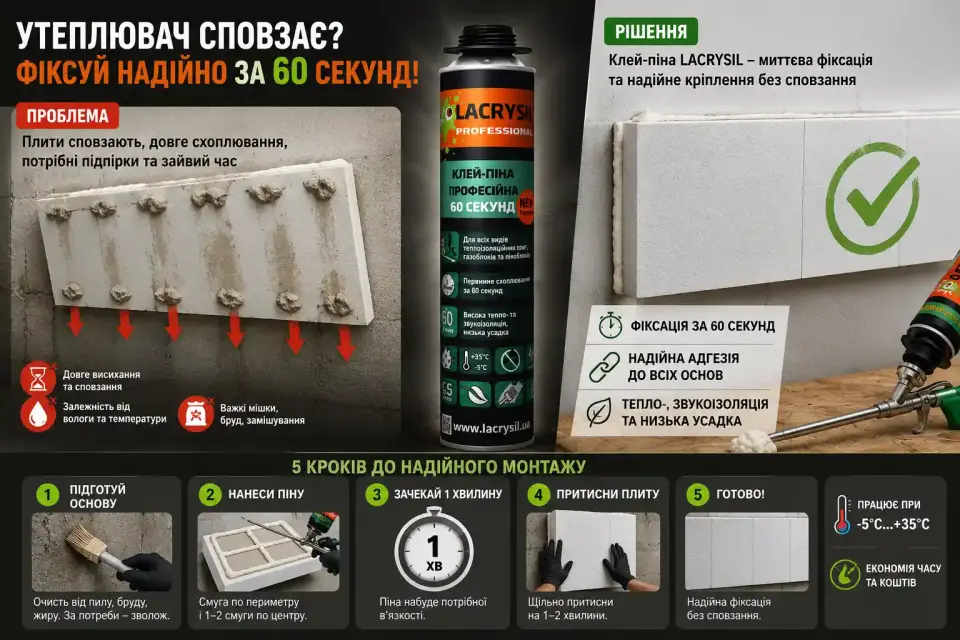
Slow setting and sliding: Traditional cement adhesives require time to gain initial strength. If the mixture is mixed with too much water or applied in a thick layer (to compensate for wall unevenness), the heavy board will inevitably "float" under its own weight.
Complex surfaces: A regular dry mix works great with brick or aerated concrete. But if you need to attach insulation to OSB, metal, wood, or a painted facade, cement adhesive is powerless here — it will simply peel off after drying.
Dry Mixes vs. Polyurethane: Which to Choose?
Installation with a dry mix is a resource-intensive process: you need water, a construction mixer, electricity on site, and the bags are heavy to lift onto scaffolding.
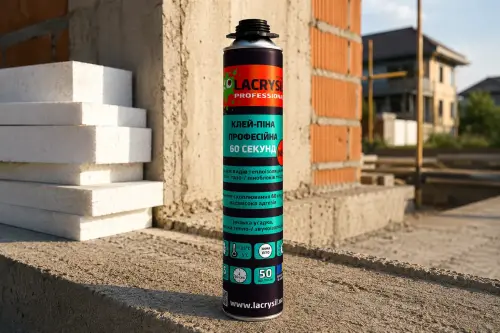
Polyurethane adhesive foam works differently. One 800 ml canister replaces a heavy bag of cement adhesive. It has excellent adhesion to almost all construction substrates, does not add weight to the facade, and provides fast initial fixation, saving hours of working time.
LACRYSIL "60 Seconds" Adhesive Foam: The Principle of Fast Fixation
For tasks where speed is critical and shifts are unacceptable, a specialized polyurethane composition is used. It works on the principle of powerful double-sided tape: you apply the compound, let it react with moisture in the air, press it — and the element is fixed.
It is ideal for installing thermal insulation boards on facades and foundations, as well as for laying foam and aerated concrete blocks.
How to Apply Foam Correctly: 5 Steps for a "Dead-Grip" Installation
Application temperature of the material: from -5°C to +35°C. The canister itself must have a temperature from +15°C to +30°C before work.
Preparation: Thoroughly clean the surface from dust, grease, ice, and buildup. At above-zero temperatures, it is recommended to slightly moisten the substrate — moisture accelerates the polyurethane reaction.
Canister preparation: Shake the canister vigorously for at least 1 minute, then attach it to the applicator gun.
Application (perimeter + center): Extrude a 1-1.5 cm thick bead along the entire perimeter of the board, 3-5 cm away from the edge. Be sure to add a couple of beads crisscross in the center for even load distribution.
Pause (critical step): Let the applied layer rest in the air for about 1 minute. It is during this time that the foam gains the necessary initial viscosity (becomes sticky but does not collapse).
Installation: Press the board firmly against the base and hold it with your hands for 1-2 minutes.
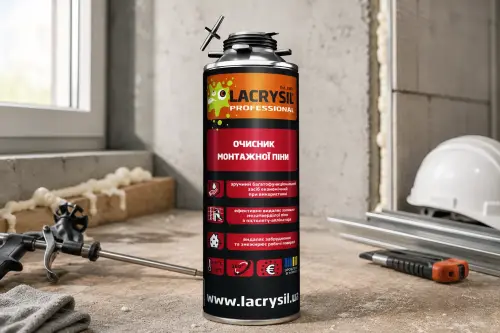
Tip: To clean the gun and remove accidental drops of uncured foam from surfaces, use the transparent LACRYSIL polyurethane foam cleaner.
Common Mistakes That Lead to Defects
Even a high-quality material won't work if the technology is violated:
Didn't wait during the pause: If you press the board immediately, the foam is still too liquid, lacks the right density, and the insulation will slide.
Installation on a dusty or greasy wall: Construction dust acts as an intermediate layer. The adhesive will grip the dust, not the wall.
Lack of sun protection: Polyurethane is destroyed by ultraviolet light. The cured layer must not be left exposed — it must be protected by plastering or painting.
Frequently Asked Questions (FAQ)
How long does the adhesive foam take to dry?
The "tack-free" time is only 3-5 minutes. The material sets in 5-30 minutes, and full polymerization (when you can start doweling) takes from 12 to 48 hours, depending on environmental conditions.What is the yield of one canister?
The exact yield depends on the thickness of the applied bead, the evenness of the base, and the temperature. There is no strict figure in square meters, as the consumption is adjusted individually for each element, but one standard canister completely replaces a bag of dry adhesive mix.Can the material be used outdoors and in damp rooms?
Yes, the adhesive foam is intended for interior and exterior work. However, it is not a finishing waterproofing — the cured seam must be protected from open water exposure.Is a special primer required before installation?
The use of specialized primers is not a strict requirement. The main rule for reliable adhesion is thorough cleaning of the base from dust and its light moistening.