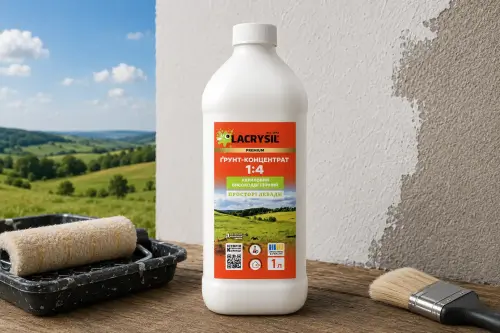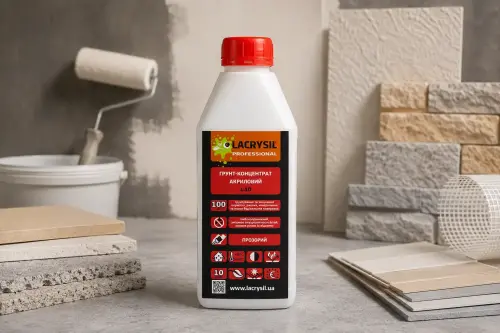



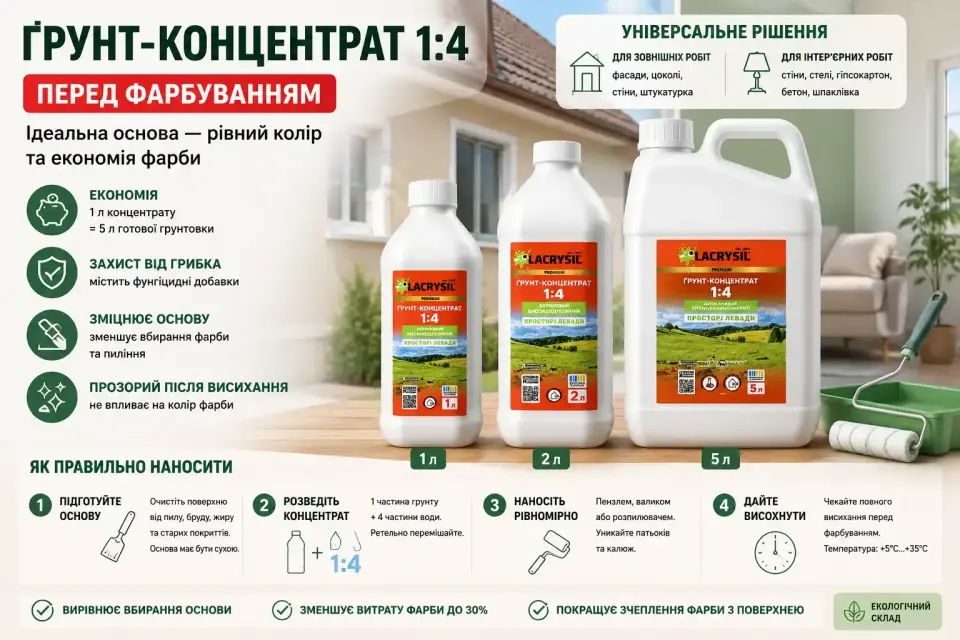
A concentrate is primer with most of the water taken out. You add the water yourself and get 5 to 11 times more working solution than you bought. The key is to get the ratio right.
Why prime
Primer evens out how the surface absorbs (without it paint goes on patchy), improves adhesion of the next coat and reduces paint consumption on porous surfaces.
1:4 or 1:10: the difference
Main use | preparing surfaces for painting | preparing for plaster, paint, textured coatings and glass-fibre wallpaper |
Dilution | 1 part concentrate + 4 parts water | 1 part concentrate + 10 parts water |
Working solution from 1 L | about 5 L | about 11 L |
After drying | transparent, does not change the surface colour | water-resistant layer |
Where | inside and outside | inside and outside |
Application temperature | +5…+35°C | +5…+35°C |
Packs | 1, 2, 5 L | 1, 2, 5 L |
Check the ratio against the label before work: if it says otherwise, the label is right.
How to dilute, step by step
Take a clean container and clean water at room temperature.
Measure the concentrate. For 1:4: 1 L of concentrate + 4 L of water = 5 L of primer. For 1:10: 0.5 L of concentrate + 5 L of water = 5.5 L.
Pour the concentrate into the water and stir.
Mix only as much as you will apply in a day.
How to apply
Clean the surface of dust, dirt, grease, old coatings and anything loose.
Apply with a brush, roller or sprayer in an even coat, without puddles.
Apply paint, plaster or filler only after the primer has fully dried.
Air and surface temperature from +5°C. In winter, prime only in a heated room.
Which one for your job
Job | Concentrate |
|---|---|
Walls and ceilings before painting in a flat | 1:4 |
Before plaster, textured coatings, glass-fibre wallpaper | 1:10 |
Facade before facade paint | 1:4 or 1:10 |
A porous surface under joint sealant A | 1:10, as the sealant card advises |
How much you need
The specifications give no separate consumption: it depends on how much the surface soaks up. Work out the area in the primer calculator and buy concentrate allowing for the ratio.
Common mistakes
Diluting by eye and too thick: a film stays on the surface and paint holds worse.
Diluting more than the ratio: the primer does not do its job.
Painting over damp primer.
Priming in frost or on a cold wall.
Frequently asked questions
What does 1:4 mean?
1 part concentrate to 4 parts water.
Do I prime before every coat of paint?
No, the surface is primed once before the first coat.
Does the 1:4 primer change the wall colour?
No, it dries transparent.