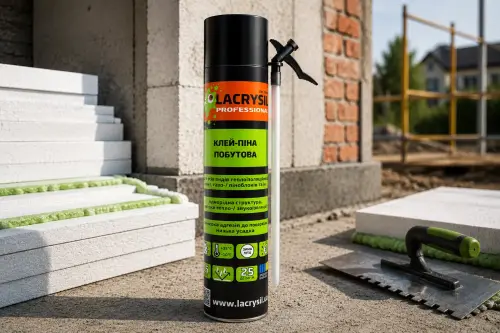
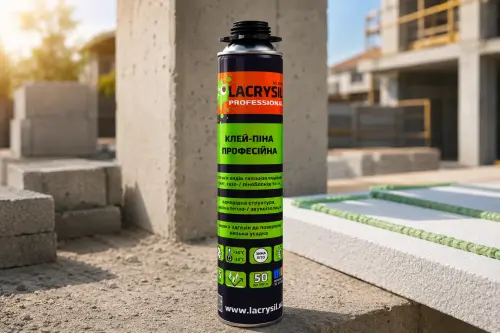
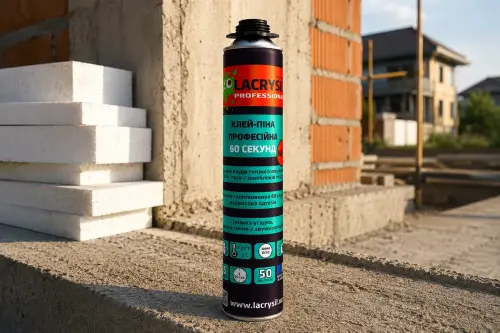
adhesive foams are used when the task is not only to fill a joint, but to bond insulation boards, panels, foam blocks or aerated concrete blocks to a base. This subcategory includes a household tube format, professional gun-grade adhesive foam and a fast “60 seconds” option for jobs where quicker positioning matters.
What adhesive foams are used for
- installing insulation boards on facades and foundations;
- fixing wall panels and separate construction elements;
- bonding foam blocks and aerated concrete blocks within the manufacturer’s recommendations;
- filling expansion joints, cavities, gaps and seams;
- sealing joints during household, construction and industrial work.
How to choose a format
- household adhesive foam with a tube is suitable for one-off jobs without an applicator gun;
- professional adhesive foam is useful for more controlled dosing and repeated installation work;
- the “60 seconds” format is relevant when a board or element needs quicker positioning after pressing;
- for larger areas and repeated application, the gun-grade format is usually more convenient;
- before choosing, check the application temperature, secondary expansion and curing time of the specific product.
What to check before installation
- the base should be cleaned of dust, dirt, grease, ice, frost and weakly bonded layers;
- at positive temperatures, the base is usually lightly moistened before application;
- adhesive foam is applied in strips or dots according to the layout for the specific material;
- after application, the element is pressed and fixed for the time stated by the manufacturer;
- the cured layer should be protected from UV exposure by painting or plastering.