


In winter, expanding foam behaves differently: it expands more slowly, takes longer to cure and easily leaves voids if the can is cold. You can still fit a window or door in frost if you pick the right foam and meet three conditions.
Which Lacrysil foams work below zero
Product | Application temperature | Use |
|---|---|---|
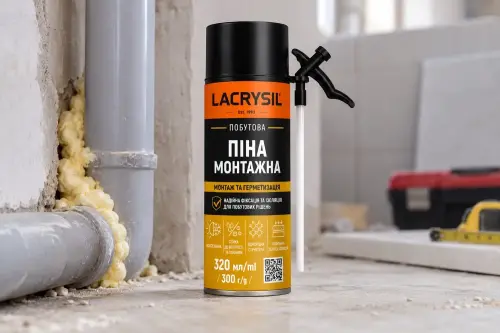
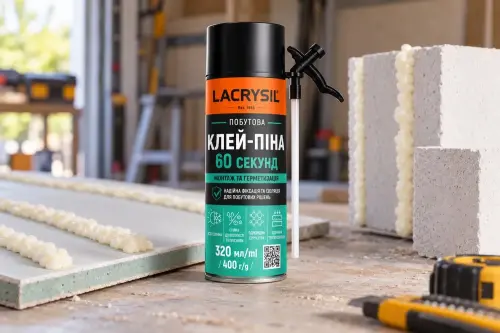
Household expanding foam (with straw) | −10…+35°C | windows, doors, gaps and holes around the house |
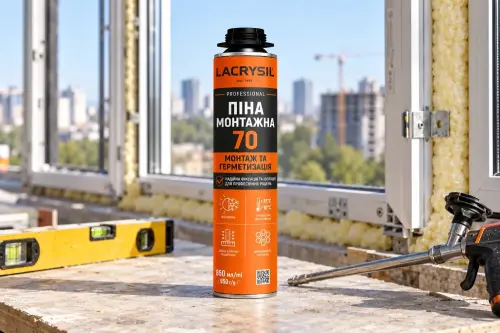
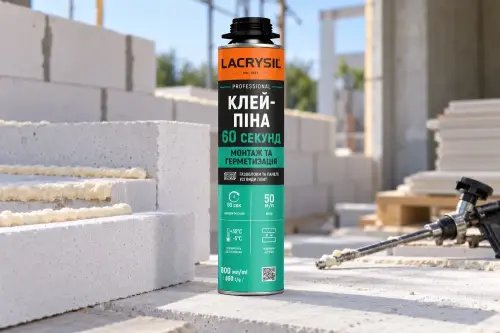
Professional expanding foam (gun grade) | −10…+35°C | window and door fitting, lower post-expansion: 150–250% against 200–400% for the household foam |
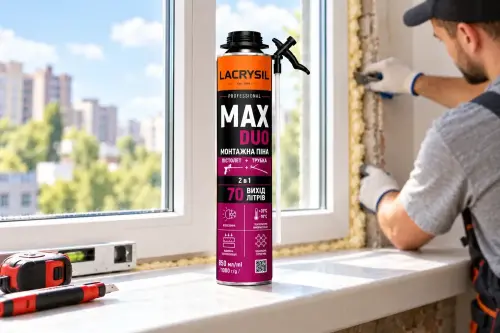
MAX DUO 2-in-1 (gun + straw) | −10…+35°C | all-purpose, for large volumes |
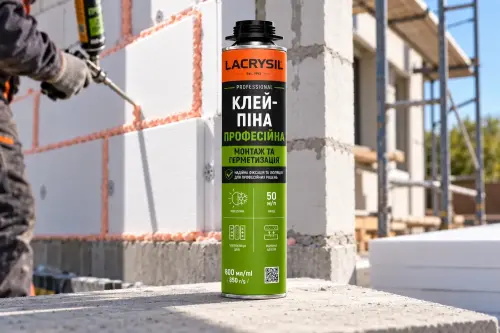
−5…+35°C | bonding EPS boards, fixing blocks | |
−10…+35°C | the same, gun grade | |
from +10°C | fire-stopping joints, only in warm conditions |
“From −10°C” is the air and surface temperature during work. The can itself must be warm.
Condition 1. A warm can
The specifications of all our foams give a can temperature of +15…+30°C. Keep the can at +18…+30°C for at least 24 hours before work and shake it for at least a minute before use. A cold can gives little foam, large pores and a sandy texture instead of an elastic joint. In winter, keep 2–3 cans in the warm and swap them in turn rather than heating them near a heater or in boiling water.
Condition 2. A clean, dry surface free of ice
Remove ice, frost, snow and dust completely: foam does not bond to ice. In summer the surface is dampened so the foam cures faster. Do not do this in winter: our foam descriptions call for dampening only above zero, and in frost the water turns to ice.
Condition 3. Air humidity
Polyurethane foam cures using moisture from the air. Our foams need relative humidity of at least 70%. Frosty air is dry, so the foam cures more slowly than the specifications say.
How to foam in frost
Fill the joint from the bottom up to about 2/3 of its volume: the foam expands into the rest.
Fill deep cavities in layers: apply the next layer once the previous one is tack-free (5–30 minutes).
Do not trim the foam before it has cured: the household foam cures in 0.5–12 hours, the professional foam in 0.5–6 hours, full curing takes 12–48 hours. In frost, count on the upper limit.
Remove fresh foam with the foam cleaner: it works from −10°C. Keep the cleaner away from expanded polystyrene.
Seal the outside of the joint the same day
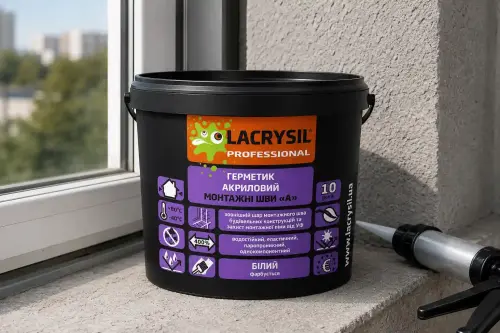
Cured foam is broken down by UV light and, in winter, by water freezing in its pores. The outer joint is sealed with joint sealant A: it is applied at −20…+35°C, so it works even when it is already too cold for foam. The inner sealant B is applied only from +5°C, so wait until the room is warm. How the joint is built and how A differs from B is covered in “Window joint sealant: A or B”.
Common winter mistakes
Mistake | Result | What to do |
|---|---|---|
Can straight from the car boot | little foam, brittle joint | 24 hours in the warm |
Dampened the surface | ice under the foam, debonding | do not dampen in frost |
Summer foam at −8°C | the joint never gains strength | check the temperature on the can |
Trimmed after an hour | voids, shrinkage | wait for curing, longer in the cold |
Left exposed until spring | the foam yellows and crumbles | seal it with sealant A |
Frequently asked questions
Down to what temperature can Lacrysil foams be used?
The household, professional and MAX DUO foams down to −10°C. The household 60-second adhesive foam down to −5°C, the professional one down to −10°C. The fire-rated foam is applied only from +10°C.
Can foam be stored in frost?
Frost resistance in storage is not stated in the specifications. For MAX DUO the manufacturer specifies storage at +5…+30°C, valve up. Keep the cans in the warm.
Why does foam sag or crumble in winter?
Most often because of a cold can, a dampened surface or dry frosty air in which the foam cures slowly.
How many cans do I need?
Use the expanding foam calculator. Foam yield is lower in the cold, so buy some extra.
Can EPS or aerated blocks be bonded with adhesive foam in winter?
Yes: the household 60-second adhesive foam from −5°C, the professional one from −10°C. How to work with it is covered in “Why insulation slips off the wall”.